
When More Isn't Better
Dermal fillers have transformed aesthetic medicine, offering physicians the ability to restore facial volume with precision and minimal downtime. Yet, as treatment popularity continues to grow, so does the number of patients presenting with an increasingly recognized complication: the Facial Overfilled Syndrome (FOS).
Contrary to popular belief, this phenomenon is not simply the consequence of injecting excessive amounts of filler. Instead, it reflects a complex interaction between facial anatomy, aging, tissue biomechanics, and injection technique.
Understanding these mechanisms is essential for achieving natural, harmonious, and long-lasting aesthetic outcomes.
What is Facial Overfilled Syndrome?
Facial Overfilled Syndrome describes the characteristic appearance that develops when facial volume restoration exceeds the anatomical capacity of the tissues.
Patients often present with:
- Rounded, excessively full facial contours
- Loss of natural facial definition
- Puffy cheeks despite aging
- Distorted facial proportions
- Reduced facial expressiveness
Ironically, treatments intended to create a youthful appearance may instead produce an artificial or swollen look.
The Hidden Anatomical Mechanism
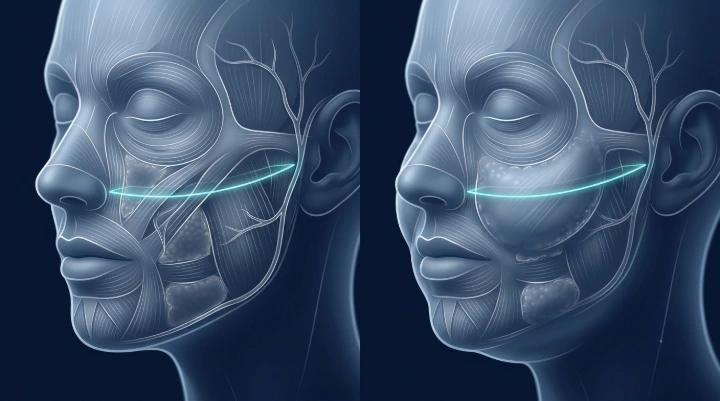
One of the most fascinating discoveries highlighted by Dr. Sebastian Cotofana is the concept of the Facial Septum Transversale.
This anatomical structure acts as a natural barrier within the midface, helping maintain proper compartmentalization of facial tissues.
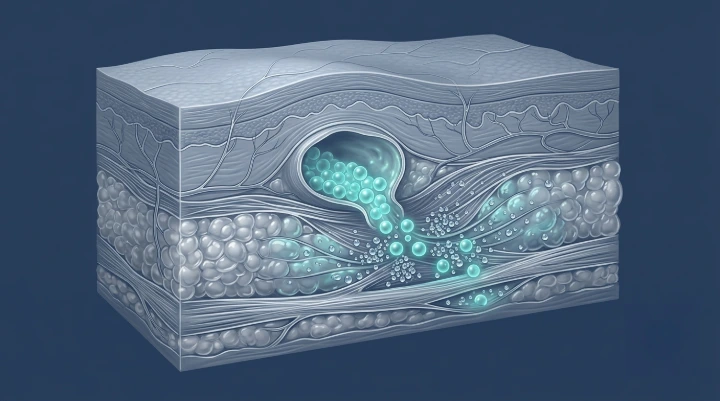
When fillers are repeatedly placed in the same anatomical regions over multiple treatment sessions, this septum can gradually become displaced or weakened. Rather than remaining confined to their intended compartments, fillers may migrate, altering the natural architecture of the face.
The result is progressive facial fullness that often appears disproportionate—even when each individual treatment seemed conservative.
Why Does the Face Become Too Voluminous?
The overfilled appearance is not solely caused by filler volume.
Several mechanisms explain this evolution:
- Progressive accumulation of hyaluronic acid
- Migration of the injected product
- Hygroscopic capacity of fillers
- Decrease in skin elasticity
- Repetition of injections in the same compartments
Together, these changes create expansion of facial soft tissues beyond their natural anatomical limits.
The Psychological Impact on Patients
Facial Overfilled Syndrome affects more than appearance.
Patients frequently report:
-Loss of self-confidence
-Feeling that they "no longer look like themselves"
-Difficulty recognizing changes until they become significant
-Social discomfort due to unnatural facial proportions
In many cases, patients seek additional filler treatments believing volume loss is the problem, when anatomical distortion is actually the underlying issue.
The Clinical Consequences
Beyond the aesthetic aspect, the Over-Corrected Face Syndrome can complicate patient management.
Practitioners may face:
- Migration of fillers
- A more complex correction
- Frequent use of hyaluronidase
- Increased risk of vascular complications
- Decreased patient satisfaction
Prevention remains the best therapeutic strategy.
Good Practices in Aesthetic Medicine
To limit risks:
✓ Inject with moderation : Small volumes placed strategically often achieve superior outcomes.
✓ Respect anatomical compartments : Knowledge of facial anatomy should guide every injection.
✓ Systematically reassess before any new injection : Evaluate facial dynamics and previous filler placement before adding volume.
✓ Restore deep structures rather than adding volume : Support the facial framework rather than chasing isolated wrinkles.
✓ Adopt a long-term view of facial aging : Natural aging should be managed progressively rather than aggressively.
Conclusion
Excellent aesthetic medicine is not defined by how much product is injected, but by how well anatomy is understood.
By respecting facial structures and adopting conservative, anatomy-driven treatment strategies, practitioners can consistently achieve results that remain natural, elegant, and sustainable over time.
"Anatomy is the foundation of safe and effective aesthetic medicine."
— Sebastian Cotofana & Hee-Jin Kim